Would you like to switch to the accessible version of this site?

Go to accessible site Close modal window

Don't need the accessible version of this site?

Hide the accessibility button Close modal window
Accessibility View Close toolbar
  • Home
  • New Patient Center
    • Online Forms
  • Eyecare Services
    • Contact Lens Exams
    • Eye & Vision Exams
    • Lasik Eye Surgery
  • Frame Selection
  • Insurance & Payments
  • About Us
    • Meet The Optometrists
    • Meet The Staff
  • Contact Us
  • Whats New
  • Community Content
    • Common Eye Conditions
      • Age-Related
      • Cognitive and Acquired
      • Vision Impairment
      • Injury & Irritation
      • Eye Lids
      • Changes in Appearance
    • Contact Lenses
    • Eye Diseases
    • Eyeglasses
      • Eyeglass Lenses
    • Eye Symptoms
    • How the Eyes Work
      • Basic Visual Skills
    • Pediatric Vision
    • Protecting Your Eyes
    • Visual Rehabilitation
    • Vision Problems
    • What is Vision Therapy
    • Vision Therapy Programs
    • We Can Help With
      • Cataracts
      • Corneal Disorders
        • Disorders
      • Glaucoma
      • Refractive Disorders
      • Adult Strabismus
      • Retinal Disorders
    • Newsletters
      • Glasses & Frames
      • Contacts
      • Tips for Healthy Eyes
      • Conditions That Affect Vision
      • Kid's Vision
      • Amazing, Interesting Eyes
      • Medical Perspectives
Enfield Eye Care Associates

(860) 749-0757

Menu
No social media links found. Please configure it

(860) 749-0757

CALL (860) 749-0757 TO MAKE AN APPOINTMENT.

Fill out the form below to sign up for our email list.

Error!

    • Home >
    • Articles >
    • Common Eye Conditions >
    • Injury & Irritation >
    • Detached Retina

    Detached Retina

    • Created in Common Eye Conditions, Injury & Irritation

    detached retina

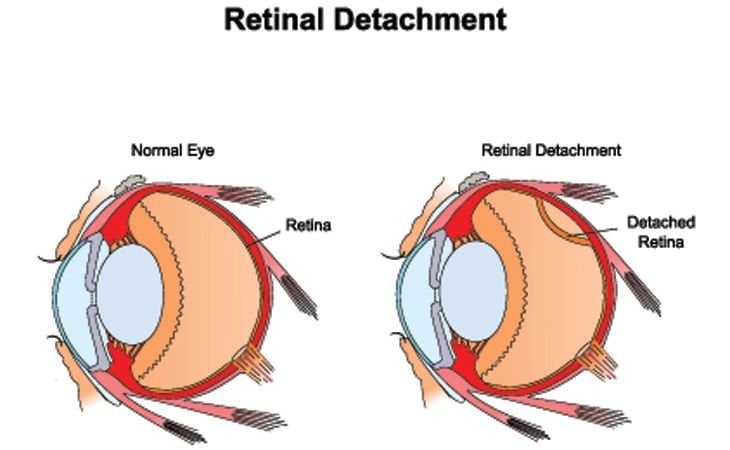
    Seeing a spot or a flash of light in your field of vision is more than an inconvenience. It could be the first signs of a detached retina. A retina becomes detached when separated from underlying layers of support tissue. Detached retinas will lead to a permanent loss of vision if they are not quickly corrected.

    Detached Retina Symptoms

    Once the retina pulls away from surrounding supportive tissue, spots, floaters, and flashes of light start appearing. Additional symptoms crop up as detachment worsens, including blurry vision or shadows descending over the eye. These symptoms can either occur gradually or suddenly depending on the speed of detachment.

    No pain is associated with these symptoms. If they occur, it is important to visit your eye doctor immediately. They can diagnose if you are suffering from a detached retina and take steps to help you regain your vision before it becomes permanently lost.

    Detached Retina Causes

    Eye or facial injuries are common causes for detached retinas. Athletes who get struck in the face or poked in the eye are usually most at risk for this method of retinal detachment.

    Detached retinas can also result in cases of extreme nearsightedness. Nearsighted people have longer eyeballs and thinner retinas that are more prone to tearing or detaching. Sometimes, fluid movement or new blood vessels growing under the retina can also pull it away from surrounding tissue.

    Cataract surgery, eye tumors, and diseases, such diabetes and sickle cell disease, can all lead to detached retinas. In extremely rare cases, retinal detachment can develop as a complication following LASIK surgery.

    Detached Retina Treatments

    Surgery is the only option for repairing a detached retina. It must receive immediate attention from an ophthalmologist who has received training to perform this surgery. Surgical reattachment doesn't always work. Success depends on the location, cause, and extent of the detachment.

    Surgical options for a detachment include:

    Scleral Buckling Surgery – a small silicone or plastic band is attached to the outside of the eye. It compresses the eye inward and lets it reattach to the interior wall of the eye.

    Vitrectomy – clear fluid is removed from the posterior chamber of the eye and replaced with clear silicone oil to push the retina back onto the supporting tissue.

    Pneumatic Retinopexy – a small gas bubble is injected into the vitreous body to push the retina back onto the supporting tissue.

    • Common Eye Conditions
      • Age-Related
      • Cognitive and Acquired
      • Vision Impairment
      • Injury & Irritation
      • Eye Lids
      • Changes in Appearance
    • Contact Lenses
    • Eye Diseases
    • Eyeglasses
      • Eyeglass Lenses
    • Eye Symptoms
    • How the Eyes Work
      • Basic Visual Skills
    • Pediatric Vision
    • Protecting Your Eyes
    • Visual Rehabilitation
    • Vision Problems
    • What is Vision Therapy
    • Vision Therapy Programs
    • We Can Help With
      • Cataracts
      • Corneal Disorders
        • Disorders
      • Glaucoma
      • Refractive Disorders
      • Adult Strabismus
      • Retinal Disorders
    • Newsletters
      • Glasses & Frames
      • Contacts
      • Tips for Healthy Eyes
      • Conditions That Affect Vision
      • Kid's Vision
      • Amazing, Interesting Eyes
      • Medical Perspectives

    Hours of Operation

    Our Regular Schedule - By appointment only due ot COVID-19

    Monday:

    By Appointment Only

    8:00 AM-7:00 PM

    Tuesday:

    By Appointment Only

    8:00 AM-6:00 PM

    Wednesday:

    By Appointment Only

    8:00 AM-6:00 PM

    Thursday:

    By Appointment Only

    8:00 AM-6:00 PM

    Friday:

    By Appointment Only

    8:00 AM-2:00 PM

    Saturday:

    By Appointment Only

    8:00 AM-2:00 PM

    Sunday:

    Closed

    Location

    Find us on the map

    • Copyright © 2026 MH Sub I, LLC dba iMatrix.
    • Admin Log In
    • Site Map