
Would you like to switch to the accessible version of this site?

Go to accessible site Close modal window

Don't need the accessible version of this site?

Hide the accessibility button Close modal window
Accessibility View Close toolbar
  • Home
  • New Patient Center
    • Online Forms
  • Eyecare Services
    • Contact Lens Exams
    • Eye & Vision Exams
    • Lasik Eye Surgery
  • Frame Selection
  • Insurance & Payments
  • About Us
    • Meet The Optometrists
    • Meet The Staff
  • Contact Us
  • Whats New
  • Community Content
    • Common Eye Conditions
      • Age-Related
      • Cognitive and Acquired
      • Vision Impairment
      • Injury & Irritation
      • Eye Lids
      • Changes in Appearance
    • Contact Lenses
    • Eye Diseases
    • Eyeglasses
      • Eyeglass Lenses
    • Eye Symptoms
    • How the Eyes Work
      • Basic Visual Skills
    • Pediatric Vision
    • Protecting Your Eyes
    • Visual Rehabilitation
    • Vision Problems
    • What is Vision Therapy
    • Vision Therapy Programs
    • We Can Help With
      • Cataracts
      • Corneal Disorders
        • Disorders
      • Glaucoma
      • Refractive Disorders
      • Adult Strabismus
      • Retinal Disorders
    • Newsletters
      • Glasses & Frames
      • Contacts
      • Tips for Healthy Eyes
      • Conditions That Affect Vision
      • Kid's Vision
      • Amazing, Interesting Eyes
      • Medical Perspectives
Enfield Eye Care Associates

(860) 749-0757

Menu
No social media links found. Please configure it

(860) 749-0757

CALL (860) 749-0757 TO MAKE AN APPOINTMENT.

Fill out the form below to sign up for our email list.

Error!

    • Home >
    • Articles >
    • Vision Problems >
    • Double Vision

    Double Vision

    • Created in Vision Problems
    hand holding tablet

    Double vision, also known as “seeing double” or the medical term diplopia, is the perception of two images of a single object. This occurs when two nonmatching images are sent to the part of the brain that processes visual input. Over time, the brain eventually begins to compensate for this misinformation by suppressing one signal so that only a single image is perceived. There are many different causes for double vision, ranging from life-threatening to benign. Consequently, when diagnosing double vision and creating a treatment plan, it is critical for a medical professional to determine the specific cause in order to develop an appropriate treatment plan.

    Symptoms of Diplopia

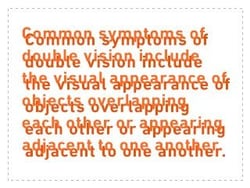
    Common symptoms of double vision include the visual appearance of objects overlapping each other or appearing adjacent to one another. This visual overlap can vary as the affected individual turns or tilts his head or gazes from side to side.
    There are two types of double vision: monocular and binocular. With monocular diplopia, double vision is affecting both eyes and does not resolve itself when a single eye is covered. For binocular diplopia, the eyes are simply misaligned and when one eye is covered, the condition is resolved. Each eye is seeing the correct single image when working alone, but when the eyes are working together, the brain perceives two adjacent images.

    Diagnosis and Treatment

    Correctly diagnosing the cause for diplopia is essential to developing an appropriate treatment plan. An eye care professional will start by taking a detailed medical history, including when the problem first began, whether it was a sudden onset or developed gradually, and whether the double vision is a frequent problem or an intermittent concern. The eye care professional will conduct a physical examination to measure visual acuity in each eye. This is necessary to determine whether the double vision is monocular or binocular.

    An eye care professional will also examine how shifting the head’s position affects the double vision. If a neurological cause is suspected, close attention will be paid to the pupils and eyelid position when looking for ocular or orbital abnormalities. In some cases specialized imaging, like an MRI, may be necessary.

    Treatment for double vision depends on the cause. In the case of monocular diplopia, refractive errors can be corrected with glasses or contact lenses; if cataracts are the cause, surgery can correct this problem. For binocular diplopia, however, a serious condition is typically associated with the eye misalignment. Correctly diagnosing the disease, like diabetes, high blood pressure, or myasthenia gravis is essential to determining the appropriate course of treatment.

    • Common Eye Conditions
      • Age-Related
      • Cognitive and Acquired
      • Vision Impairment
      • Injury & Irritation
      • Eye Lids
      • Changes in Appearance
    • Contact Lenses
    • Eye Diseases
    • Eyeglasses
      • Eyeglass Lenses
    • Eye Symptoms
    • How the Eyes Work
      • Basic Visual Skills
    • Pediatric Vision
    • Protecting Your Eyes
    • Visual Rehabilitation
    • Vision Problems
    • What is Vision Therapy
    • Vision Therapy Programs
    • We Can Help With
      • Cataracts
      • Corneal Disorders
        • Disorders
      • Glaucoma
      • Refractive Disorders
      • Adult Strabismus
      • Retinal Disorders
    • Newsletters
      • Glasses & Frames
      • Contacts
      • Tips for Healthy Eyes
      • Conditions That Affect Vision
      • Kid's Vision
      • Amazing, Interesting Eyes
      • Medical Perspectives

    Hours of Operation

    Our Regular Schedule - By appointment only due ot COVID-19

    Monday:

    By Appointment Only

    8:00 AM-7:00 PM

    Tuesday:

    By Appointment Only

    8:00 AM-6:00 PM

    Wednesday:

    By Appointment Only

    8:00 AM-6:00 PM

    Thursday:

    By Appointment Only

    8:00 AM-6:00 PM

    Friday:

    By Appointment Only

    8:00 AM-2:00 PM

    Saturday:

    By Appointment Only

    8:00 AM-2:00 PM

    Sunday:

    Closed

    Location

    Find us on the map

    • Copyright © 2026 MH Sub I, LLC dba iMatrix.
    • Admin Log In
    • Site Map